
Most roof problems start with the contractor, not the shingles. In Tulsa, hail, wind, and summer heat push roofs hard, and poor installation causes more than 65% of roof leaks. So before I sign with any roofer, I’d check 10 things: Oklahoma registration, insurance, Tulsa-area experience, certifications, warranties, written scope, crew oversight, cleanup, energy options, and local references with storm photos.
Here’s the short version:
- Check Oklahoma CIB registration first
- Ask for liability insurance and workers’ comp proof
- Make sure they know Tulsa weather and your roof type by following a residential roof replacement guide
- Ask what maker certifications they hold
- Get all warranties in writing
- Require a full written estimate, not a vague bid
- Find out who will be on the roof each day
- Ask how they protect your property and handle cleanup
- Review cooling and ventilation options
- Ask for local references and storm claim records
A few hard facts matter here. Tulsa often sees 2–3 major hail events a year, and attic heat can top 150°F in summer. That means bad ventilation, weak flashing, or rushed labor can turn into leaks, blown shingles, or warranty trouble fast.
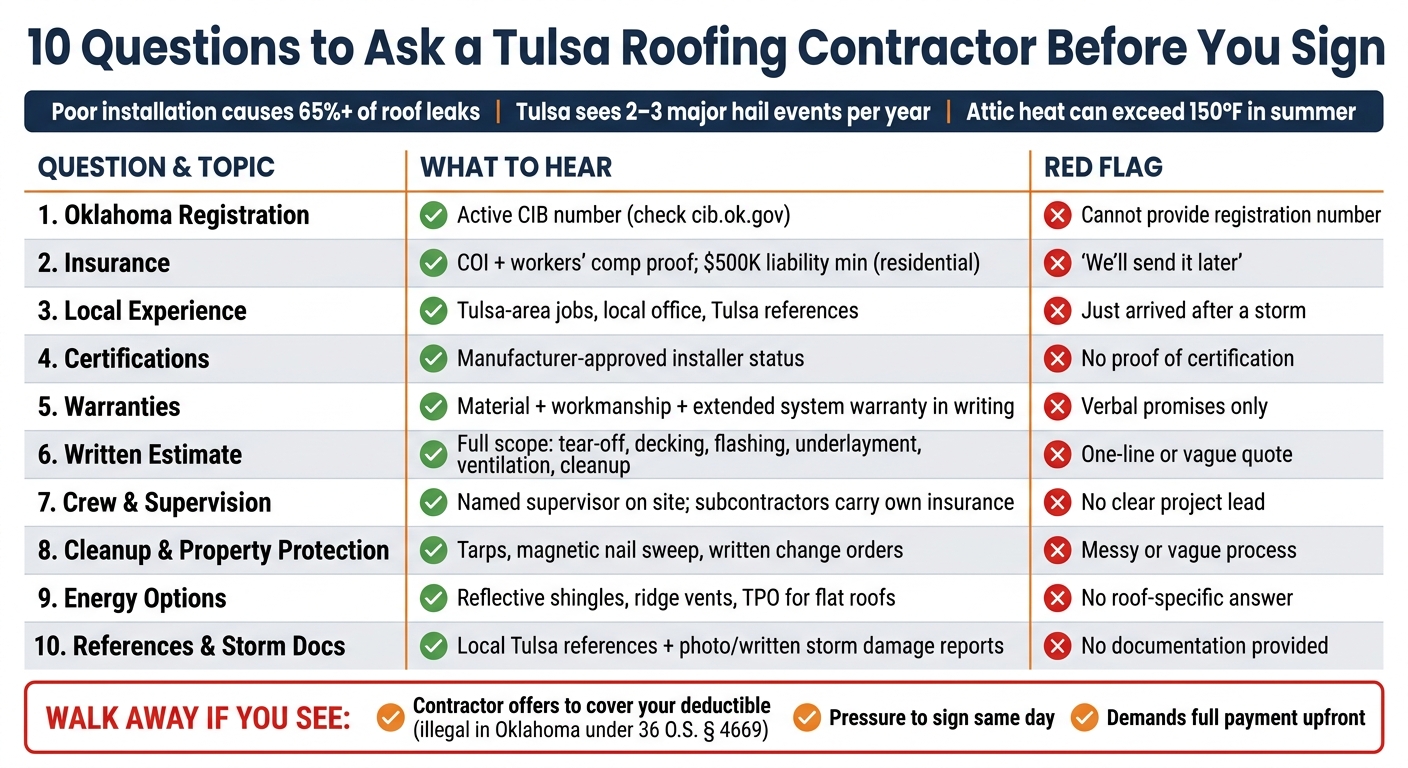
10 Questions to Ask a Tulsa Roofing Contractor Before You Sign
Quick Comparison
| What I’d Check | What I Want to Hear | Red Flag |
|---|---|---|
| Registration | Active Oklahoma CIB record | Can’t give number |
| Insurance | COI + workers’ comp proof | “We’ll send it later” |
| Local experience | Tulsa-area jobs and references | Just arrived after a storm |
| Certifications | Maker-approved installer status | No proof |
| Warranty | Material + workmanship details | Verbal promises only |
| Estimate | Full scope in writing | One-line quote |
| Crew | Named supervisor on site | No clear lead |
| Cleanup | Tarps, nail sweep, written change orders | Messy or vague process |
| Energy options | Ventilation and reflective choices | No roof-specific answer |
| Storm support | Photos and written damage notes | No documentation |
If I saw pressure to sign fast, a promise to cover my deductible, or a demand for full payment up front, I’d walk away.
sbb-itb-6a78eb0
Step 1: Verify Oklahoma licensing, insurance, and local experience
Before you ask about price or materials, start here. Registration, insurance, and local experience are the three fastest ways to screen out risk. If a contractor can’t clear these basics, they’re not worth a second call.
Question 1: How long have you been licensed and registered in Oklahoma?
Every roofing contractor in Oklahoma must be registered with the Oklahoma Construction Industries Board (CIB). You can check active status at cib.ok.gov using the contractor’s name or registration number. If they can’t give you that information right away, that’s a bad sign.
Ask how long they’ve been working in the Tulsa area and whether they have a local office or crew. A contractor with roots in Sand Springs, Broken Arrow, Owasso, Bixby, or Muskogee is usually a safer bet than someone who showed up right after a storm. And starting July 1, 2026, residential roofers also need a Residential Roofing Endorsement on top of standard CIB registration.
Question 2: Can you show proof of general liability insurance and workers’ compensation?
This part may feel boring, but it’s where a lot of trouble starts. Before any work begins, ask for these three documents:
- The CIB registration certificate
- A Certificate of Liability Insurance (COI)
- Proof of workers’ compensation coverage or a valid exemption affidavit
Oklahoma sets clear minimum coverage amounts: $500,000 in general liability insurance for residential work and $1,000,000 for commercial projects. When you get the COI, make sure the insured name matches the contractor’s registration. Also check that the CIB is listed as the certificate holder. Then confirm the policy with the insurance carrier yourself.
“The contractor must furnish proof to the CIB of general liability insurance in an amount not less than $500,000 for residential roofing contractor work.” – Oklahoma Construction Industries Board
Workers’ comp matters just as much. If someone on the crew gets hurt on your property and the contractor doesn’t have coverage, that mess can land on you.
Question 3: What local experience do you have with Tulsa weather and building types?
This is the question that helps you spot the locals and weed out storm chasers. A roofer with Tulsa-area experience knows what Oklahoma weather can do: severe thunderstorms, hail, high winds, and big temperature swings. They should also know how those conditions affect both shingle roofs and low-slope systems like TPO.
In Oklahoma, harsh weather can cut a roof’s lifespan by 30–40% compared to national averages. That’s a big gap, and it means installation choices matter. Ask whether the contractor works on your roof type all the time and how their process is meant to hold up under Tulsa weather over the years. If the answer feels slippery or generic, take that as a warning.
If they clear these checks, then it makes sense to move on to certifications, warranties, and the written estimate.
Step 2: Ask these 10 questions before you sign
If a contractor made it through the licensing, insurance, and local experience checks in Step 1, don’t stop there. Now you need to look at the fine print stuff: certifications, warranties, estimates, crew oversight, and energy performance.
This is where you spot the gap between a roofer who does the job the right way and one who just throws out a low price. These questions help you find out whether you’re getting a roof that meets code, not just a cheap bid.
Questions 4–6: Certifications, warranties, and written estimates
Question 4: What manufacturer certifications do you hold?
Certifications matter because they can affect both how the roof is installed and what warranty you get. Ask what certifications the crew has and what those certifications let them offer in warranty terms.
Higher certification levels usually open the door to better warranty coverage. If a non-certified contractor installs a premium roofing system, the manufacturer may void the warranty or limit it to basic material-only coverage.
Question 5: What warranties come with this project?
There are three warranty types you need to understand:
- Manufacturer warranty: covers material defects, like cracking or granule loss
- Workmanship warranty: covers installation mistakes, like leaks or blow-offs
- Extended system warranty: covers both materials and labor, but only when a certified installer does the work
That last one is a big deal. Extended system warranties are only available through certified installation. If the crew isn’t certified, that option is off the table.
Question 6: Will you provide a detailed written estimate before I sign anything?
Don’t accept a vague estimate. A proper written estimate should spell out the full scope of the job, including tear-off, decking repair, flashing, underlayment, ventilation, cleanup, warranty registration, and payment terms. If any of that is missing, ask why.
“A roofing contract should not just say ‘replace roof.’ It should describe the full system, including: Decking, Underlayment, Flashing, Shingles or metal panels, Ventilation, Cleanup, [and] Warranty registration.” – Honor Roofing & Construction
Once the scope and price are clear, the next step is simple: find out who’s actually doing the work.
Questions 7–8: Crew supervision, safety, and cleanup
Question 7: Who will actually be on my roof, and who supervises them?
Ask whether the crew members are employees or subcontractors. If the company uses subcontractors, check that those workers carry their own liability coverage and have manufacturer certification.
You should also ask who will supervise the project on site each day. A project manager or lead supervisor helps keep the work in line with manufacturer specs, which can protect your warranty and cut down on install mistakes.
Question 8: How do you protect my property and handle cleanup?
A solid roofing crew should protect your home while they work and leave the place clean when they’re done. That usually means tarps over landscaping, protection for driveways and gutters, and a magnetic nail sweep after tear-off.
If the crew finds hidden damage, they shouldn’t just tack on extra charges and keep moving. That damage should be documented, and you should approve the added cost in writing before the work goes further.
Questions 9–10: Energy performance, references, and storm documentation
Question 9: What energy-efficient options are available for my roof type?
In Tulsa, summer heat can make your roof a factor in both comfort and monthly utility bills. Ask about reflective shingles, TPO for flat roofs, ridge vents, and other ventilation options. Then ask which ones make sense for your roof type and local climate.
Question 10: Can you provide local references and storm documentation?
Ask for recent references from Tulsa-area jobs. If a contractor stands behind their work, they should be open to sharing names from past local projects.
For storm damage claims, ask whether they provide photo proof of what they found, such as dents in gutters or bruising on shingles, along with written reports for insurance support. That paperwork can help a lot when you’re dealing with an adjuster.
If any answer sounds fuzzy or incomplete, treat the contract review as your next checkpoint before you sign.
Step 3: Watch for red flags and review the contract carefully
Now put the contract next to the answers you already got. If something doesn’t match, stop right there.
Red flags that should stop the process
A contractor who offers to waive, pay, or “absorb” your insurance deductible is showing a major red flag. In Oklahoma, that is illegal under 36 O.S. § 4669.
If a contractor fails any of these checks, end the process before you sign.
| Red Flag Behavior | Trustworthy Contractor Behavior |
|---|---|
| Offers to waive or “cover” your insurance deductible | Requires the homeowner to pay the full legal deductible |
| “Sign today” pressure or door-to-door sales after a storm | Provides a written estimate and allows time for review |
| No physical local office; out-of-state plates or 800-number | Verifiable Tulsa-area address and local 918 phone number |
| Requires full payment up front | Uses a milestone-based schedule – deposit, progress, final |
| Vague estimate with no material or scope details | Itemized scope covering underlayment, flashing, and ventilation |
| No proof of workers’ compensation insurance | Provides an active COI listing both liability and workers’ compensation |
What the final roofing contract should include
Get every promise in writing. The contract should include the legal business name, CIB number, Tulsa address, current insurance, exact materials, full scope, dates, weather delay terms, payment schedule, change-order process, cleanup, and both warranties.
For payments, a 20% to 30% deposit is a common setup, with later payments tied to milestones. The contract should also spell out cleanup, nail sweep, and change-order approval. If hidden damage shows up, it should be photographed and approved in writing before the work moves forward.
Conclusion: Use the 10-question checklist before you commit
Use this checklist to vet any Tulsa roofing contractor before you sign anything. If a contractor passes all 10 questions and the contract looks right, you’re in good shape to move ahead. A solid contract should spell out the materials, payment schedule, cleanup duties, and permit duties before work begins.
One thing matters more than the shingle brand: installation quality. A poorly installed roof can cause headaches no matter what product goes on top. And if something feels off, trust that instinct. If a contractor pushes you to sign on the spot, won’t share insurance documents, or refuses to put key terms in writing, walk away. Then use the pages below to double-check what you were told.
Internal resources to review next
Use these Quality Roofing Systems pages to confirm the same points you just checked, like credentials, reviews, inspection details, and the right roof type for your Tulsa roof system.
- About Quality Roofing Systems – Review the company’s Tulsa presence and licensing status.
- Customer Reviews – Read reviews for communication, cleanup, and storm response.
- Free Roof Inspection – Schedule a roof inspection to assess current condition.
- Residential Roofing – Explore asphalt shingles and energy-efficient roof systems.
- Commercial Roofing – Review TPO, metal restoration, and polyurethane foam systems.
FAQs
How do I verify an Oklahoma roofer’s CIB registration?
Visit the official Oklahoma Construction Industries Board website and use its online search tool to confirm that the contractor’s registration is active and in good standing.
You can also check the owner’s name, business address, and renewal date. Registered contractors must display their CIB registration number on their website, marketing materials, and vehicles.
What should a roofing estimate include?
A professional roofing estimate should be a detailed written document that clearly lays out the scope of work and the total cost.
It should also include:
- An itemized breakdown of labor and materials
- Project start and completion dates
- Payment terms
- Insurance claim procedures
- Warranty details for workmanship and materials
- Any possible added costs
This kind of estimate gives you a clear picture of what the roofer plans to do, what it will cost, and what to expect from start to finish.
How much should I pay upfront for a new roof?
Discuss the payment schedule with your contractor before you sign anything. Upfront payments can vary, but a solid contractor should spell out the terms clearly in the written agreement.
Also, steer clear of any contractor who says they can waive your insurance deductible. That’s prohibited by Oklahoma law. And no matter how straightforward the job seems, make sure all costs and all project details are put in writing.